
How to Be Heard in a World Where Everyone Is Shouting
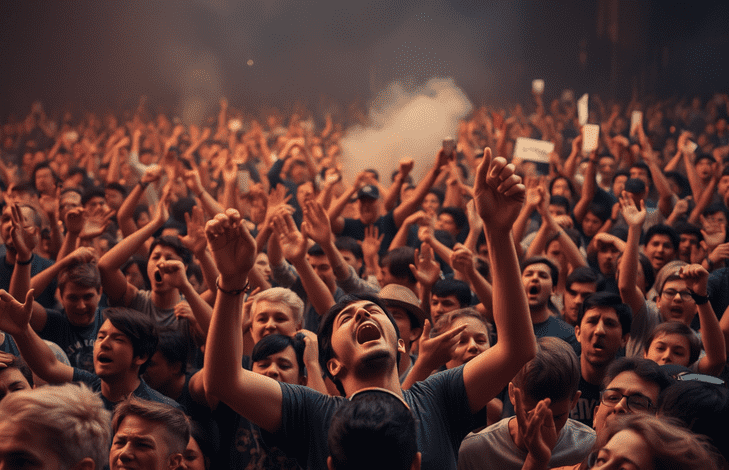
“Angels speak in whispers — and those who are willing to listen draw closer.”
We live in an age in which volume has become a substitute for authority, in which whatever shouts the loudest is automatically perceived as more urgent, more relevant, more deserving of attention, and in which nuance, proportion, and complexity are increasingly treated as weaknesses rather than strengths; and I am not referring only to physical noise — though that too is everywhere, from music blasted at full volume in every public space to portable speakers that turn any corner into an improvised nightclub — but to a far more pervasive and insidious form of noise, which is informational, commercial, and emotional.
Open any platform and you are assaulted by headlines promising miraculous transformations, instant wealth, effortless success, bodies reshaped in seven days, fortunes made in Dubai, pills that solve problems that once required discipline and patience, while every banner, every notification, every flashing message repeats the same imperative: look at me, click me, buy me, follow me; meanwhile, social media has become a permanent version of a sports bar argument in which reasoning is optional, subtlety is suspect, and the most effective rhetorical tool is no longer argument but insult or dismissal, so that those who refuse to align with the prevailing narrative are not refuted but simply ignored, muted, or blocked — because genuine dialogue requires mental energy, and mental energy, in an environment of constant stimulation, is becoming scarce.
In such a context, a serious, well-argued, realistic proposal — one that does not promise seven kilograms in seven days nor millions without effort but speaks instead of sustained work, discipline, and depth — is inevitably drowned out by background noise, like a voice attempting to speak softly in a stadium where others are shouting through megaphones; this is not merely an artistic problem but a structural one that affects any field in which complexity matters, because the trainer who offers a six-month program grounded in gradual progress cannot compete, on the plane of immediate attention, with the magic pill, and if he were to try, he would undermine his own method before even beginning.
The classical musician, however, embodies this tension in its purest form, because his or her art, by definition, lives through silence and proportion: to truly hear a nocturne by Chopin or a quartet by Beethoven requires more than an instrument and performers; it requires a space in which pianissimi can exist, in which dynamics are not flattened, in which the breath between phrases is not swallowed by noise; to blast that music at stadium volume would be to destroy its very essence, and it is no coincidence that the classical musician does not perform with a microphone, because the power of that tradition lies not in amplification but in concentrated intensity, tonal refinement, and the precision of gesture.
Here the decisive question emerges: if the world rewards those who shout, does it make sense to attempt to win on the terrain of shouting? For anyone who works seriously, the answer must be negative — not out of moral superiority but out of coherence — because competing with the loudest voices would require adopting their codes, simplifying complexity, exaggerating effect, sacrificing substance, and ultimately becoming a lesser imitation of something that already exists in more spectacular and more aggressive forms.
There is, however, another path, which does not consist in retreating into isolation nor in lamenting cultural decline, but in understanding that silence, today, has become rare and therefore valuable; the old expression that angels speak in whispers is not merely poetic but strategic, because it suggests that what truly carries weight does not need to overpower everything around it, but instead requires an interlocutor willing to draw closer.
Not everyone is willing to do so, and it would be naïve to assume otherwise; there exists an audience that seeks intense stimulation, immediate excitement, constant entertainment, and it is not to that audience that a pianissimo, a carefully shaped phrase, or a long-term developmental process will appeal; yet there also exists — and perhaps it is larger than we imagine — a group of individuals who are exhausted by noise, weary of exaggerated promises, fatigued by relentless stimulation, individuals who have not entirely lost their capacity for sustained attention and who can still distinguish between being struck and being transformed.
Reaching such people is not a matter of purchasing visibility but of constructing contexts, of creating physical and intellectual spaces in which listening becomes possible, of accepting perhaps smaller numbers but deeper relationships, of communicating with sobriety and coherence rather than spectacle; in other words, it requires the deliberate creation of oases of silence within a desert of noise, environments in which value is not measured in decibels or clicks but in the quality of attention.
The challenge, therefore, is not to be heard by everyone, which would require self-distortion; it is to be heard by those capable of understanding, and this demands a conscious choice: to refuse competition on the terrain of shouting and to embrace the far more demanding task of speaking quietly, trusting that those with ears to hear will make the effort to come closer.
In a world that pushes relentlessly toward excess, the most radical gesture may no longer be to raise the volume even further, but to defend the space in which a pianissimo can still exist.
by Bruno


