
Virtuosity or Technical Exhibition?
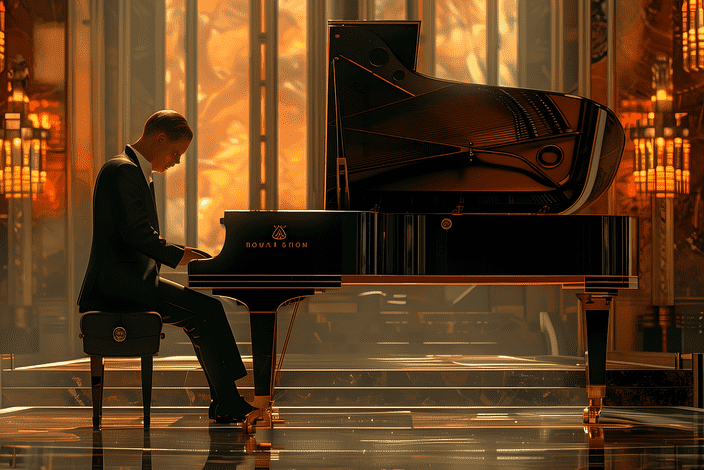
The word virtuosity does not enjoy a particularly good reputation. In music, it is often associated with pure technical exhibition, with a kind of circus-like display that impresses without necessarily saying anything. A show of skill that captures attention for a moment, but rarely leaves a lasting trace.
And yet, in this distrust, something essential is often forgotten: the etymological root of the word is virtue. And virtue, in its original sense, has nothing to do with tricks or special effects. It refers instead to a stable quality, a strength, a capacity that allows a person to stand, to act, to express themselves fully.
This is why, when I speak about the qualities required of a truly high-level musician, I prefer the term virtuosity. Not as a linguistic whim, but because it describes a broader and deeper concept. Technical mastery — obviously indispensable — is only one of the components that make a musician complete. On its own it is not enough, yet without it everything else remains fragile.
Virtuosity, in this sense, is the integrated mastery of many dimensions: mechanical, psychological, artistic, interpretative. It is the ability to manage one’s instrument, one’s body, attention, mental energy, performance pressure, and the relationship with the audience. Not as separate elements, but as parts of a single system that functions coherently.
This global mastery is not an end in itself. On the contrary, it is what makes genuine artistic expression possible. If part of the attention is absorbed by technical concerns, fear of mistakes, or excessive control, contact is broken. True communication cannot occur, because the performer is still busy managing rather than speaking.
When these components are sufficiently integrated, something different happens. Technique fades into the background, tension dissolves, and that rare and almost indescribable condition becomes possible — the one in which the musician does not perform the music, but becomes it, together with the audience. There is no longer a clear separation between those who play and those who listen: there is a shared, living, unrepeatable experience.
The problem is that traditional musical education often stops short of this point. It focuses almost exclusively on technical and stylistic aspects, neglecting everything considered “extra-musical”: psychological skills, motivation, stage presence, the ability to withstand pressure, even communicative and promotional competence. The result is a well-trained but incomplete musician, left alone to find their way through trial and error.
Virtuosity begins precisely where these gaps are addressed. Not by adding complexity, but by removing obstacles. For this reason, perhaps the most useful question to ask is not how do I get through that difficult passage?, but something more radical: how can I allow the musical idea to manifest itself without being obstructed by technical or psychological issues? That is where technical exhibition dissolves — and true virtuosity begins.
by Bruno


